Providence's mission of compassion extends far beyond the hospital walls

Foundations of Health
When the pandemic landed in Alaska, and crowded homeless shelters and facilities had to rethink their spaces to accommodate adequate social distancing in order to prevent the spread of COVID-19, Providence joined with the City of Anchorage and other local agencies to convert the city’s 8,600-seat Sullivan Arena into an emergency shelter. Its success in providing shelter to more than 400 people at a time and keeping infection rates low among one of the highest-risk populations garnered national attention.
Removing Barriers to Care
Many of the 400 people who came to Sullivan Arena needed more than just a roof over their heads. It’s no secret that people experiencing homelessness are at higher risk of physical health issues, mental health problems, and substance abuse. Bean’s Café ran into a number of challenges in the Sullivan, some of which were significant behavioral health issues that posed a significant dilemma – trespass the individuals and put the individual and community at risk during COVID or provide the needed care and services onsite. Bean’s contacted Providence asking for help.
Providence responded by convening key community partners. The result was a new partnership with Anchorage Neighborhood Health Center (ANHC) and Southcentral Foundation (SCF) to set up a full-service clinic in the box office of the arena. Providence, ANHC, and SCF diverted staff, resources, and equipment to provide medical care, behavioral health care, and even an onsite pharmacy. There was also help for substance use, addiction, and withdrawal from psychiatrists, both in person and via makeshift telehealth terminals.
“This way, when these individuals begin to decompensate and have self-management challenges due to mental health conditions, we could be there to help stabilize them and stop them from triggering others,” says Johnson. “If those individuals with substance use issues or mental health conditions would’ve been put out on the street, it wouldn’t have been safe for them or the community.”
Increasing Community Resilience
Mental health is another issue that perennially appears on Providence’s community needs assessments. But the pandemic—the health crisis itself, the adverse economic impact, and the effects of the social isolation—has only heightened the importance of access to behavioral health care, particularly for adolescents.
That’s why Providence has partnered with Volunteers of America (VOA) Alaska to embed behavioral health counselors in Anchorage School District (ASD) schools. This will boost delivery, raise awareness of the need for services, and bolster the community’s overall ability to coordinate care among youth.
“We recognize the incredible need, particularly during the pandemic and its impact on our young people,” says Lindsie Mills, grants manager with Providence Alaska Foundation. “It’s really timely to be talking about this issue and engaging in this work.”
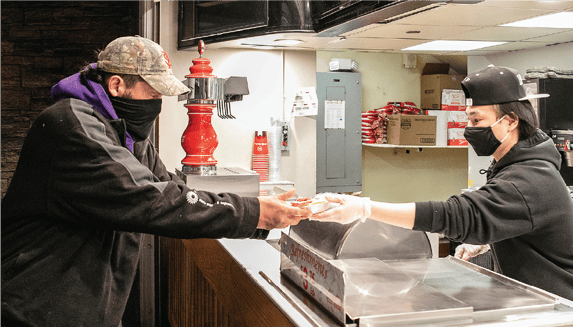
Another key problem facing children and families throughout Alaska is food insecurity. Providence addressed this by funding the Children’s Lunchbox Program to make certain that children spending almost the entire year learning remotely from home got the food they needed.

Lindsie Mills, Grants Manager, Providence Alaska Foundation
Innovating for the Future
In addition to investing in the innovative integrated care models by having mental health clinicians embedded in schools, medical clinics, and other institutions, Providence is devoted to using technology to increase access and improve care to the community.
Even before the pandemic, Providence was investing in remote and out-of-clinic access to care by adding telepsychiatry to the Providence Alaska Medical Center emergency room in Anchorage and other facilities throughout the state. This enabled patients who were living in remote rural areas with limited transportation options, debilitating conditions, or time constraints to receive psychiatric medications, treatment, and help with acute intoxication and withdrawal.
But during the pandemic, Providence saw a system-wide 30% increase in telehealth visits for all patients looking to shelter in place and slow the spread of COVID-19. And Providence is ensuring that these advancements remain in place and improve after the pandemic.
Health For a Better World
These are just some examples of the many ways Providence has used its people, resources, and money to reach out, beyond the confines of the hospital, to help improve the overall health of the community around them. But while Providence brings considerable resources to the table, none of this would be possible without cooperation and buy-in from the community.
"All of this would not be possible without our community partners,” says Preston Simmons, DSc., FACHE, chief executive of Providence Health & Services Alaska. “We are honored to work alongside you and be trusted in providing care to our fellow Alaskans, and grateful for all those who shared our dedication to health for a better world. Thank you for everything you do to take care of those in need.”