Angels in Sneakers: Andrew Jenkins Discovers Hope, Healing and a New Life After Stroke

On a warm June evening in 2021, Andrew Jenkins was doing what he had done countless times before — putting his two kids to bed and settling onto the couch with his wife Jessica at home in the Tri-Cities.
Nothing about that night suggested what was about to happen next.
“I rested my head, and my body just stopped responding,” Andrew recalled. “I knew something was wrong.”
Within moments, his speech disappeared. His wife recognized the urgency and called 911. By the time paramedics arrived, Andrew could no longer answer questions. Soon after, he lost consciousness.
Andrew was having a massive stroke.
A Race Against Time
Andrew was initially taken to a local hospital before being airlifted to Providence Sacred Heart Medical Center — an essential step in stroke care, where time can mean the difference between recovery and permanent damage. “Time is everything,” explained Providence neurosurgeon, Dr. Benjamin Ling. “The sooner you can reestablish blood flow to the brain, the better the chances of saving brain tissue and preserving function.”
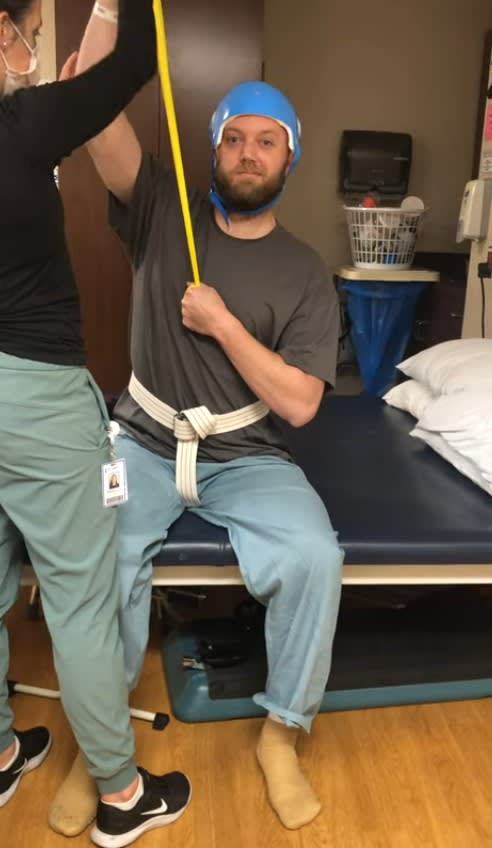 In Andrew’s case, a blood clot blocked blood flow to his brain. The stroke caused severe swelling in his brain, creating life-threatening pressure. To save his life, Dr. Ling performed an emergency surgery called a hemicraniectomy where part of the skull is removed to allow the brain to swell safely outward instead of compressing vital structures.
“If left unchecked, that swelling can be fatal,” Dr. Ling said. “Removing part of the skull allows us to save the brain and sometimes even restore function.”
Andrew spent eight days on life support as the care team worked to stabilize him.
Lost Words, Unbroken Spirit
When Andrew woke up, the world was no longer the same.
The stroke had affected the left side of his brain — home to language — and left him with global aphasia, meaning he struggled both to understand language and to speak.
After leaving SHMC, Andrew’s recovery journey continued at Providence St. Luke’s Rehabilitation Medical Center, where he spent 21 days in intensive inpatient rehabilitation.
“When Andrew first arrived, he couldn’t engage in conversation or follow commands, and his speech was mostly unintelligible,” said Dr. Frank Jackson, brain injury program medical director at St. Luke’s.
At the same time, Andrew faced significant physical challenges. His right side was weakened, and he was unable to lift his arm or leg against gravity. Inside, however, his awareness remained.
“In my head, everything made sense,” Andrew said. “But when I spoke, nothing made sense.”
At St. Luke’s, a multidisciplinary team made up of physicians, therapists, nurses, and psychologists worked together to rebuild his independence.
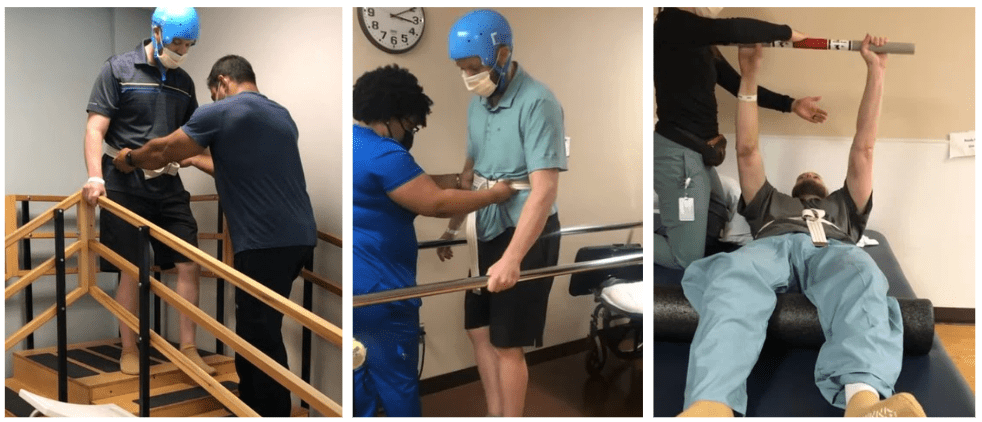
Andrew’s days were filled with physical therapy to regain strength and mobility. Occupational therapy to relearn daily tasks like brushing his teeth and grocery shopping, and speech therapy to help rebuild language from the ground up.
When Andrew first arrived, he required maximum assistance just to stand. By discharge three weeks later, he could walk over 200 feet using a walker with minimal support.
Angels in Sneakers
Throughout his journey, Andrew said he found strength not only in therapy but in God and the people around him.
He often refers to his caregivers at SHMC and St. Luke’s, as “angels in sneakers.”
“They pushed me when I didn’t want to be pushed,” he said. “They believed in me when I couldn’t see it yet.”
He said that his family also stood strong beside him. “My wife and my family didn’t just cheer me on, they walked beside me,” Andrew said.

Recovery didn’t happen overnight. It took years of persistence, patience, and faith. Today, Andrew continues to improve. He has returned to work, regained independence, and continues to strengthen his speech.
He describes himself as transformed.
A Message for Stroke Awareness Month
Today, Andrew is using his voice, something he once feared he had lost forever to help others.
He shares his story publicly, hoping to inspire patients and families beginning their own recovery journeys.
Andrew’s story is also a reminder of how quickly stroke symptoms can appear and how critical it is to act fast.
· Sudden loss of speech or confusion
· Weakness or numbness, especially on one side
· Difficulty moving or responding
· Loss of consciousness
If you notice these signs, call 911 immediately.
Because as Andrew’s story shows every second matters, and every step forward is possible with the right care.
Watch Andrew's heartfelt message to the caregivers who helped save his life: Angels in Sneakers video